Report owner
1. Select the report
Choose one recurring deck and agree what a successful handoff must preserve.
Bring
Recent finished deck; PowerPoint template; Named reviewers
Keep
Scope and acceptance criteria; Reviewer ownership
Evaluation guide
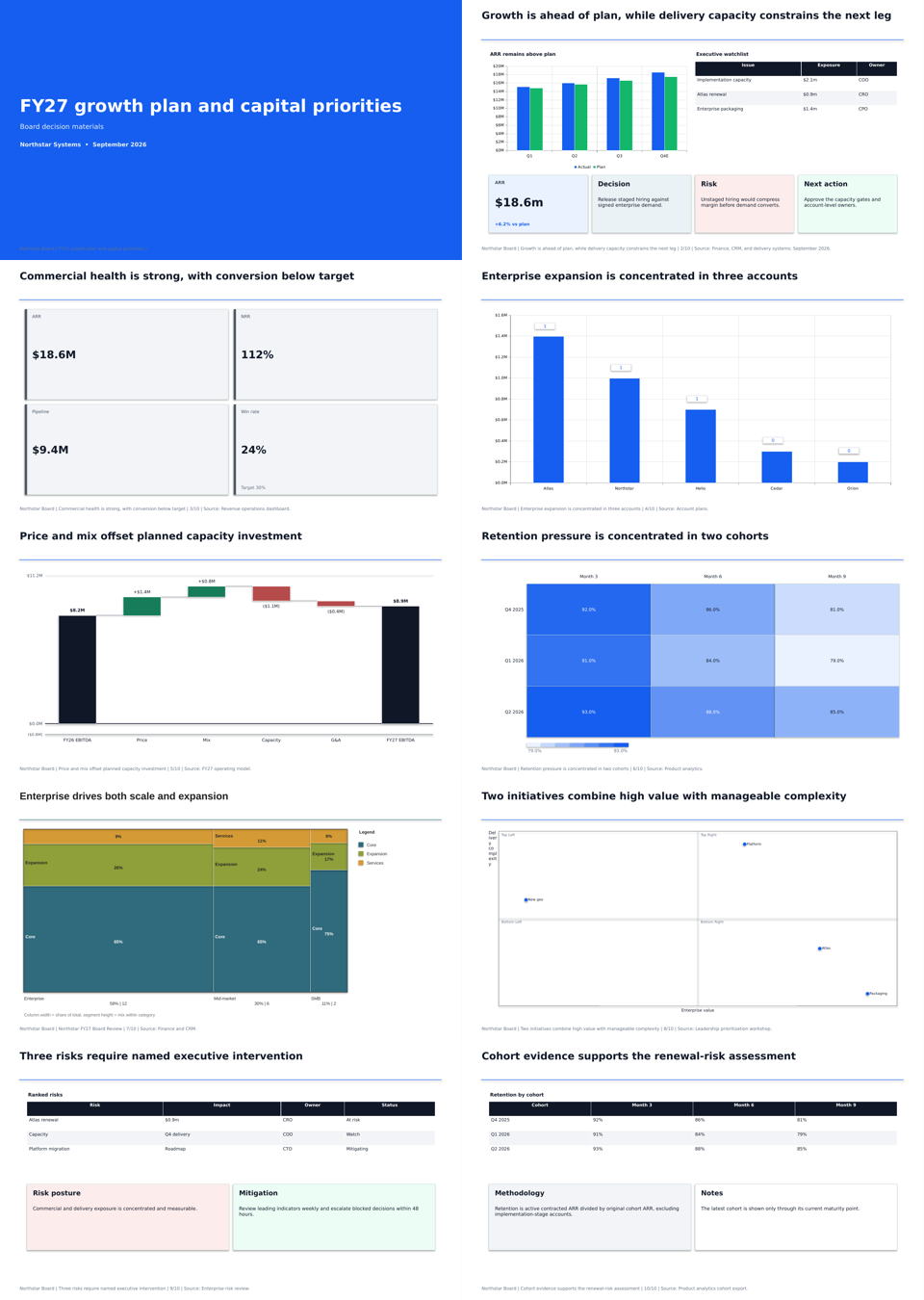
Use your source data, PowerPoint template, and reviewers. Agree on acceptance criteria before generating anything, then compare two reporting periods and inspect the editable deck.
Start with the real constraints
One recurring deck is enough to reveal most workflow and design gaps.
A finished deck and its editable PowerPoint template.
Approved data or analysis for two reporting periods.
Logo, fonts, color tokens, and any required footer or disclosure.
An analyst, a design owner, and a person accountable for the report.
Evaluation path
Choose one recurring deck and agree what a successful handoff must preserve.
Recent finished deck; PowerPoint template; Named reviewers
Scope and acceptance criteria; Reviewer ownership
Reconcile source values before judging generated visuals.
Two reporting periods; Source extracts; Definitions and units
Source snapshot; Reconciliation notes
Select layouts, map semantic slots, and review fonts, colors, logo, and footer rules.
PPTX master; Brand tokens; Editability requirements
Mapped package version; Font and token review
Inspect real slide rasters and editable PowerPoint output; record exceptions by slide.
Validated deck spec; Mapped package; Source snapshot
Generated PPTX; Raster proof; Named review notes
Regenerate the next period and compare accuracy, editability, design fit, effort, and cost against baseline.
Second period; Reviewer notes; Manual-work baseline
Two run manifests; Change and exception log; Go/no-go decision
Decision gate
Thresholds belong to your team. A local technical pass is not a customer design sign-off, a Microsoft PowerPoint fidelity guarantee, or proof of token-cost savings.
What to inspect
Our published example is representative product evidence, not a substitute for your template review.